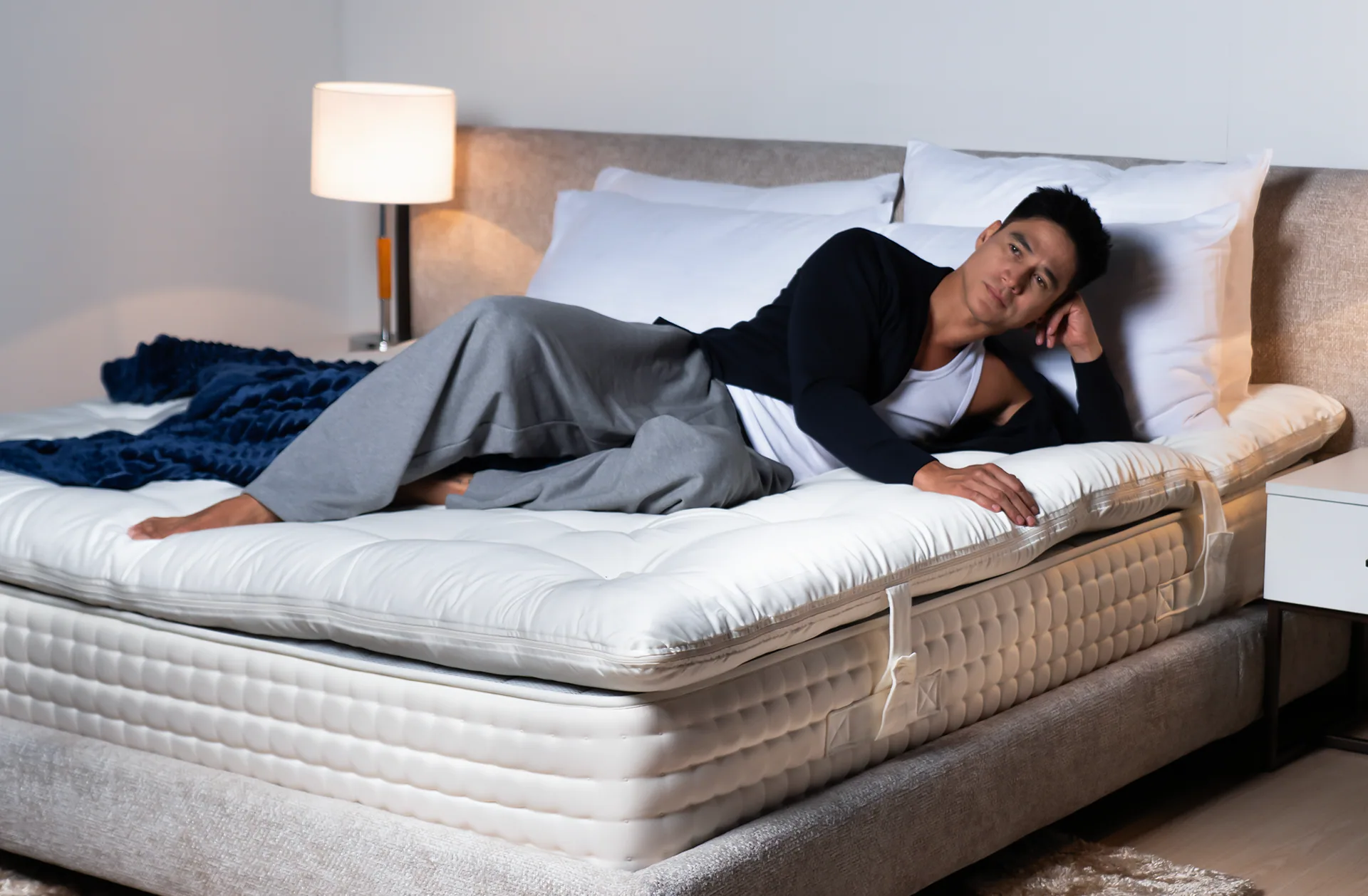

How Temperature Affects Sleep Quality
March 3, 2026
You can have the best mattress and still wake at 3 AM sweating or freezing. Why sleep is deeply temperature-sensitive — and how thermal balance shapes recovery.
You can have the best mattress, the perfect pillow, and still wake up at 3 AM because you are either sweating or freezing.
Most people blame stress, caffeine, or screen time. Rarely do they blame temperature.
Yet sleep is highly temperature-sensitive. In fact, your body cannot enter deep, restorative sleep without a shift in thermal regulation.
The human body operates on a circadian rhythm that controls when you feel alert and when you feel sleepy. As night approaches, your core body temperature naturally drops. This internal cooling signals the brain to release melatonin, preparing you for sleep.
If this cooling process is disrupted, sleep depth is compromised.
When the body becomes too warm, it struggles to transition into deep sleep stages. Overheating increases movement, causes micro-awakenings, and reduces REM stability. Even if you stay asleep, your recovery quality declines.
On the other end, when the body becomes too cold, muscles tighten and circulation shifts to preserve warmth. Instead of fully relaxing, the body maintains low-level tension throughout the night. You may not consciously notice it, but you wake up feeling stiff or unrested.
Sleep is not just about comfort. It is about thermal balance.
Your mattress plays a direct role in this balance. The sleep surface is in constant contact with your body for six to eight hours. If it traps heat excessively or fails to provide warmth when needed, it interferes with the body’s natural sleep signals.
This is where controlled heating technology becomes relevant.
Unlike adding another blanket or adjusting room air conditioning, an integrated manual customizable heating system works at the contact layer. Gentle surface warmth supports muscle relaxation, encourages better blood circulation, and reduces stiffness. For individuals who experience cold sensitivity, joint discomfort, or muscle tightness, controlled heat can significantly improve sleep onset and comfort stability.
Proper warmth can also shorten sleep latency. When the body feels thermally comfortable, it relaxes faster. Internal temperature can decline naturally without the stress of external cold exposure.
In climates where air conditioning is heavily used, surface warmth becomes even more important. A room may be cool, but the body still requires balanced micro-temperature to maintain consistent sleep cycles. Manual heating customization allows adjustment based on personal tolerance and seasonal variation.
Temperature is a biological trigger. It influences hormone release, muscle tension, circulation, and sleep depth.
When thermal balance is optimized, heart rate stabilizes, movement decreases, and deep sleep becomes more sustainable.
Many people think their sleep problem is stress or aging. Sometimes it is simply temperature misalignment.
Sleep quality is not just about how long you rest. It is about whether your body is in the right thermal state to recover.
And sometimes, the difference between restless nights and restorative sleep is just a few degrees.
Ready to feel the difference?
Explore the Zleep AI collection and find the system built for the way you sleep.